
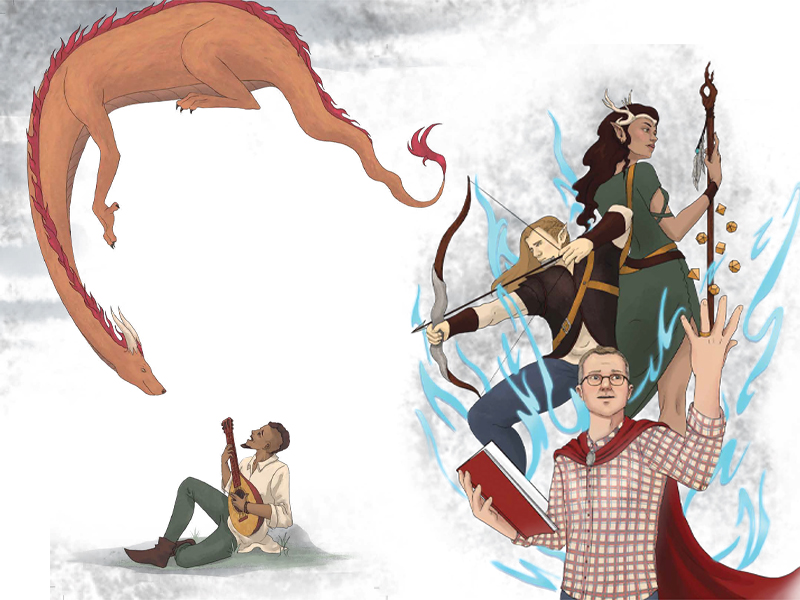
Here be Dragons… and They’re Friendly
Writer Tyler Hellard reflects on how Dungeons & Dragons — a game he learned to love as an adult — has become more popular than ever as a force for good in a chaotic world
To the uninitiated, it might feel like Dungeons & Dragons is having a resurgence. And it is. The game has been around since 1974, but was mostly played by teenagers. About a decade ago, D&D released its Fifth Edition, streamlining the rules and giving the whole thing a fresh coat of paint.
It got pop culture bumps from shows like The Big Bang Theory and Stranger Things, and then its own blockbuster tie-in film, 2023’s Dungeons and Dragons: Honor Among Thieves, starring Chris Pine. It also proved popular during the COVID-19 pandemic, giving people a reason to Zoom with friends and talk about the problems of Faerûn, the fictional setting for much of D&D, instead of those in the real world. And those 1970s and ’80s teenagers, most now middle-aged, are rediscovering D&D and teaching their kids. The game is everywhere.
I grew up in a small town where you were the sort of kid who played hockey or you played D&D. While some kids might have done neither, there wasn’t a single kid who did both. I played hockey. In my world, D&D was played by nerds, dorks and skids. You know, weirdos. And if it seems like my social paradigm was informed almost exclusively by narrow-minded teen movies released between 1986 and 1994, well, you’d be right.
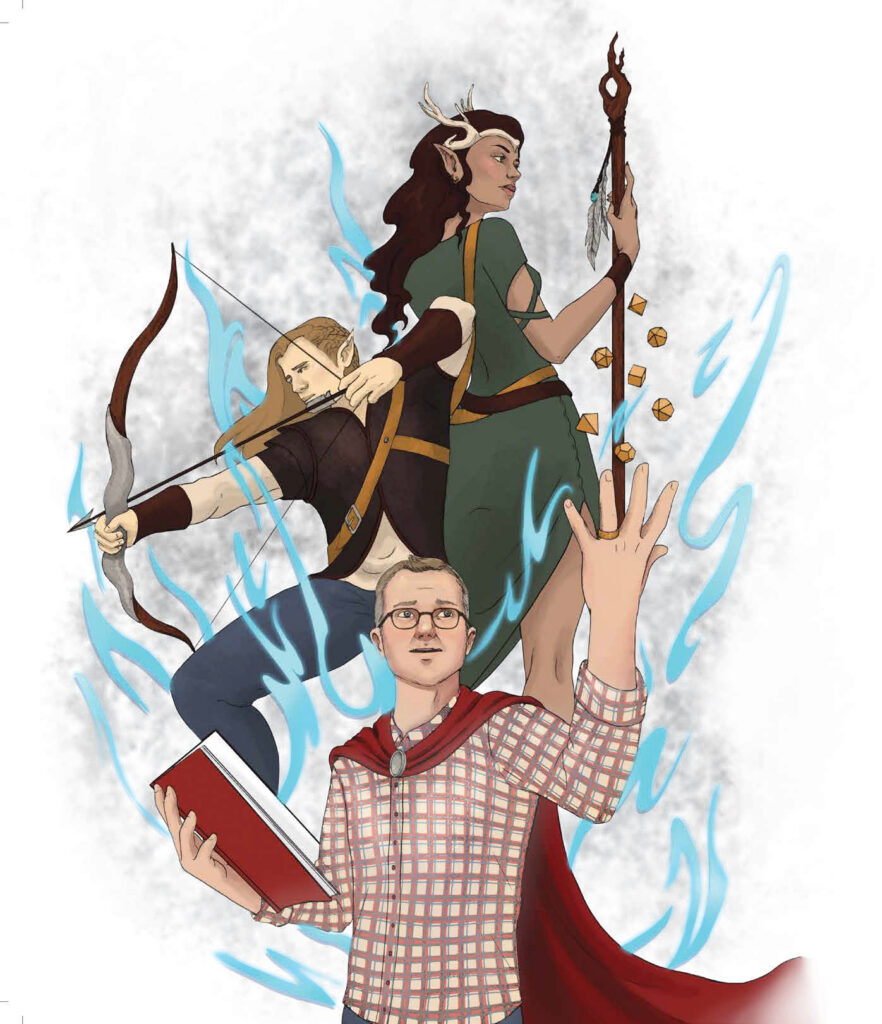

Illustrations by Sarah L. Shaneman
NEXT GENERATION D&D
Calgarian Dionne Angman, also part of my demographic cohort, remembers it like I do. “When I was a kid, it was more the nerdy kids who would play D&D.”
But her kids, 16-year-old Deia and 18-year-old Blake, don’t see it that way. “To a degree, it still is nerds,” says Blake. “But now the definition of the term ‘nerd’ has expanded. Really anybody can do it.” What follows is the four of us fumbling around, trying to come up with a modern definition of nerd. We never really land on one, and it’s not something that seems to concern the kids all that much anyway. Presumably, they were raised on better movies.
Blake and Deia have built a community playing Dungeons & Dragons for the last seven years through a youth program organized by the Alexandra Writers’ Centre Society (AWCS). The program is ostensibly a youth writing group that uses D&D as a storytelling mechanism, and its quirk is that it is directed by its participants.
“The kids decide what they want, and we put it into action,” says Kim Firmston, AWSC’s director of youth education. After being introduced to D&D as a form of storytelling, the kids decided they wanted more. One game quickly became several.
“When we moved in 2017, we expanded it, and when COVID-19 hit, we pulled it online and kept going quite successfully,” says Firmston. “Once we came back [in-person], the kids wanted to play more often. We ended up getting so many kids that we run three programs every second week and three more programs on the alternate weeks.” She estimates anywhere from 50 to 75 kids now play each year.
D&D is a natural fit for a writing program. Players get to invent characters with nuanced traits and rich backstories. Play requires engaging with the story’s narrative and contributing to it, with fateful choices ultimately left to a dice roll. It’s also a game where failure can be every bit as entertaining as success. It’s good for imagination, but AWCS’s game also stresses skills beyond the creative.
“They have to work together, so we’re encouraging listening skills, teamwork, leadership, but also ‘followship’ [where kids learn to take direction],” says Firmston. “It’s about how they are all supporting the group.”
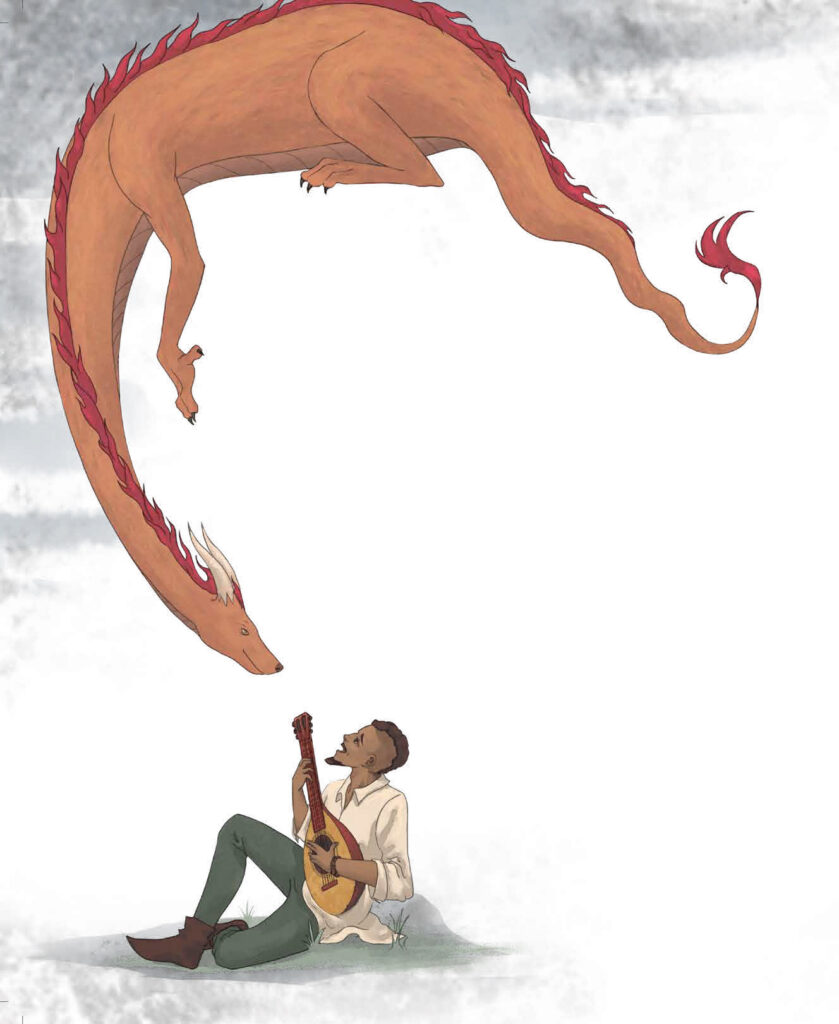
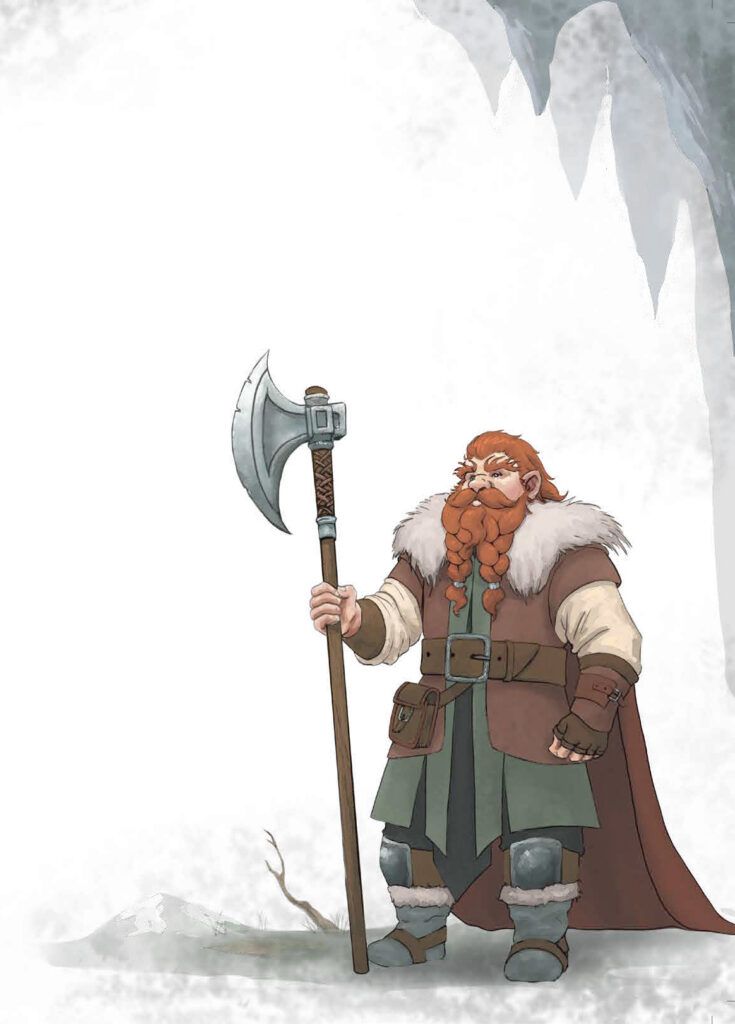
Illustrations by Sarah L. Shaneman
SOCIALIZING MADE EASIER THROUGH D&D
Firmston recognizes the value of D&D as a social tool. There are a lot of reasons people might struggle socially, including those living with anxiety, ADHD or who are on the spectrum. More recently, it could be kids who lost two years of social interaction and group play to a global pandemic. Or it could just be kids suffering from the most brutal of (though thankfully nonterminal) social conditions: being teenagers.
Angman thinks D&D gives her kids space to try different roles, take risks and explore or develop their personalities. Blake and Deia mostly just see it as a fun game to play with their friends. It gives them permission to relax and be silly.
“The great part about the game and the community is that everybody’s being goofy,” says Blake. “Playing pretend in any other scenario might be looked at as weird. ‘Nobody else is doing that.’ But when you’re playing D&D, everybody’s doing that.”
The structured play is also useful for those kids who struggle to form relationships, for whatever reason. D&D, by design, creates an entirely new social context, one that offers rules on how to engage with people. It gives people who might otherwise have difficulty making connections a clear path to share experiences with others.
“A lot of our instructors are neurodiverse, and a lot of the kids that come are neurodiverse,” says Firmston about AWCS’s programs. “Everyone just kind of comes and finds their family.”
BUILT-IN INCLUSIVITY
When I press anybody I talk to about D&D and this inclusion aspect, they respond like Blake and Deia trying to pin down what a nerd is: mainly with confusion. Their answers all imply, with a hint of incredulity: “Of course D&D is inclusive.”
Renee Haverhals is the manager at the Sentry Box, Calgary’s premier store for buying tabletop games and accessories, including role-playing games like D&D, war games like Warhammer, classic board games you’ve heard of, modern board games you haven’t, gaming-related miniatures, models and so on. It stands as the closest thing D&D in Calgary has to a ground zero. Nerd mecca. In addition to selling these games, the store also hosts a dizzying array of gaming nights for every kind of player. While Haverhals enjoys the diversity she sees in the people showing up, she also adds, “I hope we’re getting closer to a time when this question seems ridiculous.”
She is right, of course, and I do feel a bit silly it took me so long to see it.
Pointing out that a game played by children also happens to be highly inclusive is ridiculous, and somehow it’s only the wizards and warlocks, the dwarves and elves, the lawful evil and chaotic good, who noticed. In addition to going mainstream, Dungeons & Dragons has also grown up. The game is now 51 years old — that’s an entire generation of nerds and weirdos stewarding it along, defining the kind of community they want to be part of. And while this capacity for kindness and acceptance started organically, even Dungeons & Dragons’ corporate owners (Hasbro when you go high enough up the chain) have signaled they want diversity and inclusion to be a part of D&D’s present and future — the most recent major update added sections on “Mutual Respect” and “Setting Expectations” to the official rules.
At a time when we are really, really, really struggling with the character of the celebrities and politicians and athletes we’re producing, the nebulously defined “nerds” playing D&D have become legion and quietly carved out a legitimate safe space where all of the moral clichés we feed to children — be nice, have fun, it doesn’t matter if you win or lose — have been internalized and actualized. D&D offers a place where everyone is, wait for it… kind! Even if their character is an evil half-demon sorcerer with proficiency in deception.
Fourteen-year-old me played hockey. Forty-seven- year-old me plays Dungeons & Dragons on Tuesday nights with a group of other middleaged men and wishes his younger self could have done both. My kids play D&D every weekend, and while they don’t play hockey, I’m certain they’d be accepting of hockey players in their game. In fact, it’s ridiculous to think they wouldn’t.
WHERE TO D&D IN CALGARY
Alexandra Writers’ Centre Society
AWCS runs D&D games across two semesters each year. They also offer an evening class on becoming a better Dungeon Master (for kids and adults), and members get access to classes, camps and more all year. alexandrawriters.org
Calgary Public Library
The library’s D&D program started online during the pandemic, but has continued and grown in-person since. “Get Started with Dungeons & Dragons” is currently running at some library locations for kids aged 13 and up. calgarylibrary.ca
Young Adventurer’s Society
“An enterprising group of Dungeon Masters, players, game enthusiasts and all around cool folk” offering weekly, monthly and one-off games and lessons for all ages. Summer camps and private sessions available. youngadventurersociety.com
Adventurer’s League Calgary
Hosted at the Sentry Box, Adventurer’s League Calgary offers weekly official campaign play for experienced and new players alike, with players aged anywhere from 12 to 60. Sign up soon — there’s often a waiting list. sentrybox.com
Go Online
Whether you want to play over the internet or find a local group to join, there is almost always a Reddit thread or MeetUp group of local players and Dungeon Masters (DM) looking to play. You can also find a DM to run games for you and your friends as a one-off or on an ongoing basis. Search “D&D in Calgary” to get started.
This article was originally published in the 2025 edition of Create Calgary, an annual magazine launched by Calgary Arts Development to celebrate the work of artists who call Mohkinsstsis/Calgary home.
You can pick up a free copy at public libraries, community recreation centres and other places where you find your favourite magazines. You can also read the digital version online here.
